

Medium Kitchen Tiles in Ireland
When people plan a new kitchen, tile size is often one of the hardest decisions. Small tiles bring detail but more grout, while large tiles look sleek but can be heavy, harder to cut and awkward in a compact room. Medium kitchen tiles sit comfortably in the middle. They give a clean, uncluttered surface with a manageable number of grout lines, yet they are still easy to handle, cut and fit around the sockets, window sills, corners and cabinets that every kitchen has. This balance makes them one of the most popular and practical choices for Irish kitchens, from compact galley kitchens in apartments to large open-plan kitchen-diners in family homes.
Medium tiles also suit almost any style. In a modern kitchen, they create a calm, ordered surface that lets handleless cabinets and stone-look worktops take centre stage. In a traditional or country kitchen, they give a familiar, classic look that feels in keeping with shaker cabinets and range cookers. Because they work on both walls and floors, medium tiles also make it easy to create a coordinated scheme across the whole room.
Why choose medium tiles for your kitchen?
The biggest advantage is balance. Compared with small tiles, medium tiles have fewer grout lines, which means a calmer look and less grout to keep clean behind the hob and sink, where grease and splashes are heaviest. Compared with large-format tiles, they are lighter and easier to handle, they need less specialist equipment to lay, and they are more forgiving on walls and floors that are not perfectly flat. They also produce fewer awkward thin cuts at the ends of worktop runs and around wall cabinets, which often happens when large tiles are used in a small space.
Medium tiles are also DIY-friendly. If you are tiling a splashback yourself, they are a comfortable size to work with: big enough to cover the wall quickly, small enough to cut cleanly with a standard tile cutter and to lift and position without help. For a kitchen renovation on a budget, this can save time and keep waste to a minimum. Finally, medium tiles keep their proportions in rooms of any size. They do not look too busy in a small kitchen, and they do not look lost on a large open-plan floor.
Where do medium tiles work best in a kitchen?
Kitchen splashbacks and walls
Medium tiles are a natural fit for the splashback between the worktop and the wall cabinets. They cover the area quickly with a neat, even grid of grout lines, and they are easy to cut around sockets, switches and window reveals. On a full-height wall, such as behind a range cooker or open shelving, medium tiles create a strong feature without the busy effect of a small tile across a large area. They also work well for tiling the full space up to a cooker hood, where a clean, wipeable surface is essential. For more on planning the splashback area, see our kitchen backsplash tiles.
Kitchen floors
On the floor, medium tiles give a practical balance between grip and easy cleaning. There are enough grout lines to add some traction underfoot, which helps in a room where water and spills happen every day, but not so many that cleaning becomes a chore. Medium floor tiles are well suited to small and medium kitchens, galley kitchens and utility rooms, and they handle the slight unevenness found in many older Irish homes better than very large tiles. In a larger open-plan space, a medium tile laid in a brick bond or offset pattern keeps the floor looking continuous and modern. Our guide to water-resisting flooring for kitchens explains what to look for in a kitchen floor.
Kitchen-diners and open-plan spaces
In an open-plan kitchen-diner, medium tiles can run from the cooking area into the dining space, creating one connected floor that ties the room together. Because the size suits both a compact kitchen zone and a larger living area, the floor looks balanced throughout. Using the same tile shape on the splashback as on the floor, or a complementary one, is a simple way to give the whole space a designed, coordinated feel.
Which styles and layouts suit medium kitchen tiles?
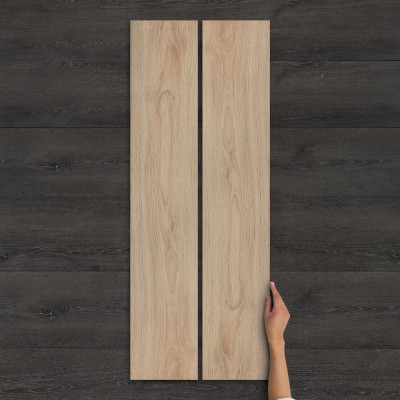
Medium kitchen tiles come in a wide range of styles and effects. As a guide, stone-effect and concrete-effect tiles give a calm, natural look that suits modern and industrial kitchens, while marble-effect tiles bring a touch of luxury to a splashback or floor. Wood-effect tiles add warmth to a kitchen floor with the durability and easy cleaning of a tile. Patterned tiles add personality to a floor or a feature splashback, and plain tiles create a simple, timeless backdrop.
The laying pattern has a big effect on the final look. A straight grid gives a clean, modern finish, while a brick bond or offset layout softens the grid and suits traditional kitchens. Laying rectangular tiles vertically can make a low splashback look taller, while a horizontal layout makes a short wall look wider. On floors, running the tiles along the length of the room helps a galley kitchen feel longer.
How do you choose colours for medium kitchen tiles?
Start with the cabinets, worktop and flooring, as these are the hardest elements to change. Light tones reflect light and help a small or north-facing kitchen feel brighter. Neutral tones are the most versatile, sitting comfortably with any cabinet colour, appliance finish and worktop, and they are easy to refresh later with new paint or accessories. Dark or bold tones create drama on a feature wall or a large, well-lit floor, and they hide everyday marks well. Grout colour also matters: a grout close to the tile colour gives a seamless finish, while a contrasting grout highlights the tile shape and layout.
How to plan and fit medium kitchen tiles
Measure the splashback or floor area carefully and allow extra tiles for cuts and breakages, especially if you are using an offset or diagonal layout. On walls, start the layout from a central point, such as the middle of the hob or window, so cut tiles fall neatly at the ends of the run. On floors, check that the subfloor is clean, dry and level before tiling, and use a suitable adhesive and grout for kitchen use. If you need to fit rails, shelves or sockets after tiling, our guide on how to drill through tiles explains how to do it without cracking the tile. Tile Merchant supplies tiles and accessories only and does not provide fitting, so we recommend using a qualified tiler if you are not confident doing it yourself.
Tiles can look different under your own kitchen lighting, so it is worth seeing them at home before you buy. Order up to five free samples delivered to your door, or visit one of our showrooms in Ireland, open seven days a week.
Frequently asked questions
Are medium tiles good for a small kitchen?
Yes. They keep their proportions in a compact room, with fewer grout lines than small tiles and fewer awkward cuts than large tiles.
Can medium tiles be used on kitchen walls and floors?
Yes. They suit splashbacks, full-height walls and floors, which makes it easy to create a coordinated look across the kitchen.
Are medium tiles easier to lay than large tiles?
Generally, yes. They are lighter, easier to cut and more forgiving on surfaces that are not perfectly flat.
What layout works best for medium kitchen tiles?
A straight grid looks modern, while a brick bond suits traditional kitchens. Running floor tiles along the length of the room helps a narrow kitchen feel longer.
Can I get samples of medium kitchen tiles?
Yes. You can order up to five free tile samples delivered to your door to compare styles in your own kitchen.