- Introduction
- Things To Consider Before Installing Tile On Underfloor Heating
- 5 Reasons We Recommend Porcelain Tiles For Your Underfloor Heating Renovation
- Best Porcelain Tile For Your Underfloor Heating: 6 Top Types Of Tile
- 3 Top Tips For Installing Porcelain Floor Tiles On Underfloor Heating
- Conclusion
- Why Tile Merchant?
Introduction
Underfloor heating is surely one of humankind’s greatest ever inventions. Say goodbye to icy feet in the middle of the night and steamy bathrooms with mirrors that never stay clear. Say hello, instead, to perfect warmth all throughout the day and night!
When it comes to selecting the right flooring for your brand-new underfloor heating system, however, it’s important you choose right..
Selecting the right flooring for an underfloor heating system directly impacts your room's thermal efficiency, warm-up time, and monthly energy bills. While several flooring materials are compatible with radiant heat, tile is widely recognized as the single best type of flooring for underfloor heating. Unlike timber or laminate, high-density tiles will not warp, cup, or shrink when exposed to fluctuating temperature cycles, nor do they act as thermal insulators that block heat flow.
Whether you are retrofitting a wet room or laying electric heat mats in a kitchen renovation, choosing the optimal tile material and format ensures fast heat transfer and long-term durability. This guide breaks down why porcelain and ceramic lead the market, how to choose the right tile thickness, and the 6 best tile choices for underfloor heating.
Things To Consider Before Installing Tile On Underfloor Heating
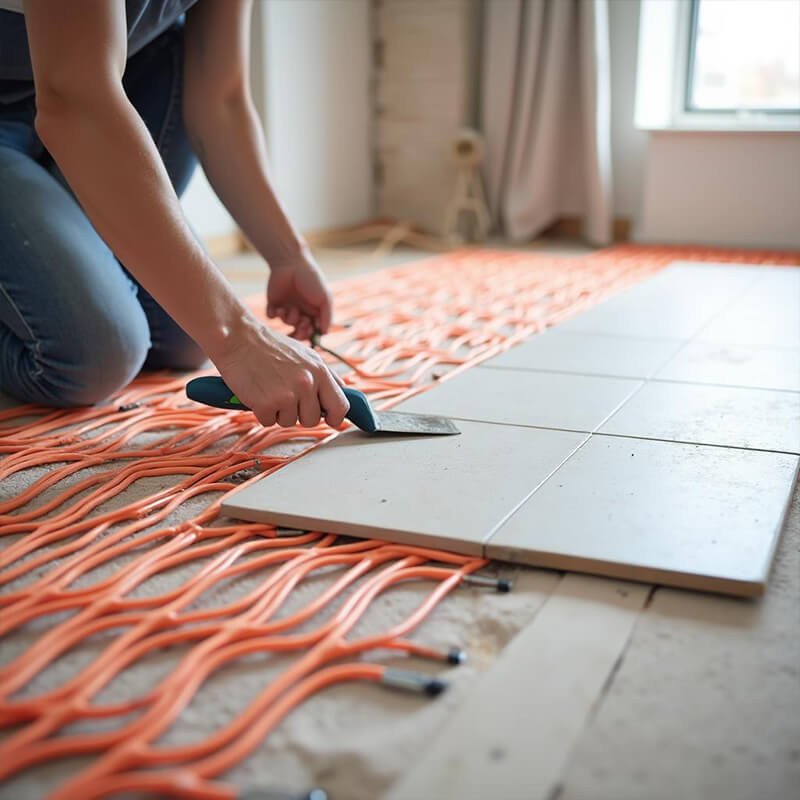
Bathroom tiles are undoubtedly the best material to install atop your underfloor heating, but how do you ensure you get the most out of your heating?
Here are a few key things to consider before tile shopping!
What’s The Best Tile Thickness To Get The Most Out Of Your Heating?
The thickness and format of your chosen tiles dictate how quickly heat moves from the subfloor to the surface. Thicker tiles create higher thermal mass, meaning they take longer to warm up initially but retain and radiate heat for longer periods once at temperature. Conversely, thin tiles heat quickly but lose thermal momentum faster.
- The 10mm Sweet Spot: A tile thickness of approximately 10mm offers the ideal compromise between rapid response time and stable heat retention for domestic radiant systems.
- Surface Area & Heat Dispersion: Large-format and extra-large format tiles maximize heat output across the room. Fewer grout joints mean fewer interruptions in the continuous tile surface, creating an uninterrupted surface for thermal radiation.
Pro tip: The size of your tiles also affects heat dispersion. We recommend using large format or extra-large format tiles when tiling a heated floor—greater surface area means greater heating!
How Warm Can a Tiled Heated Floor Get?
The European underfloor heating standard EN 1264 sets maximum floor surface temperatures for comfort and safety: 29°C in occupied living areas, 33°C in bathrooms and 35°C in perimeter (edge) zones, such as the strip in front of large windows. Your installer designs the system so the floor stays within these limits. Tile copes comfortably with these temperatures, but the limits apply whatever floor covering you choose.
What Type Of Tile Material Is Best Suited To Underfloor Heating?
When asking what flooring works best with underfloor heating, hard-surface ceramic and porcelain tiles top the list due to high thermal conductivity λ ≈ 1.05–1.3 W/m·K (Thermal conductivity: approximately 1.05–1.3 W/m·K). They absorb energy rapidly from hydronic pipes or electric cabling and transfer it evenly into the room space.
While both materials conduct heat efficiently, porcelain edges out ceramic for underfloor heating installations. Porcelain is fired at higher temperatures from denser clay, resulting in a non-porous body (water absorption rate $<0.5\%$). This ultra-dense composition handles thermal expansion stress better than lighter ceramic cores, preventing micro-fractures over extended heating cycles in high-moisture areas like bathrooms and kitchens.
We also stock an almost endlessly wide range of porcelain tiles to choose from, meaning you get full creative control over the final look of your new heated floor.
How Much Does Tile Insulate Your Underfloor Heating?
Every floor covering adds a layer of thermal resistance between the heating and the room. This is known as the R-value and is measured in m²K/W: the lower it is, the more freely heat passes through. Planning guidance based on EN 1264 recommends keeping the total floor covering at or below 0.15 m²K/W. Ceramic and porcelain tiles sit at roughly 0.01–0.02 m²K/W, well inside that limit and among the lowest of any common flooring. By comparison, PVC is around 0.025 m²K/W, parquet 0.04–0.11 m²K/W and carpet 0.06–0.15 m²K/W. That is why a tiled floor warms the room faster and at lower water temperatures.
Porcelain vs. Ceramic: Which Is Better for Underfloor Heating?
Homeowners often evaluate ceramic tiles for underfloor heating to keep material budgets down. Both materials are 100% compatible with underfloor heating, but key differences affect long-term performance:
- Thermal Efficiency: Both porcelain and ceramic tiles transfer heat effectively. However, porcelain’s higher mass density allows it to store and radiate heat more consistently across the floor surface.
- Structural Integrity: Heated subfloors undergo constant thermal expansion and contraction. Porcelain’s superior mechanical strength makes it far less susceptible to cracking under subfloor thermal movement compared to softer ceramic tiles.
- Moisture Resistance: In wet areas like wet rooms or en-suites, porcelain's non-porous structure blocks moisture from seeping down toward the heating elements or subfloor membrane.
Verdict: Ceramic tile is a good budget choice for low-traffic heated areas, but porcelain tile remains the superior investment for high-traffic, wet, or high-usage underfloor heating systems.
Living in Ireland? Visit a Tile Merchant store today and explore our stunning range of tiles and home improvement products!
Should You Install A Sub-Floor Below The Tiles Or Not?
Yes! Absolutely yes!
A properly prepared and installed subfloor is essential to the effectiveness, efficiency and longevity of your new underfloor heating system.
Unevenness or movement in a subfloor can cause cracking in tiles and downward heat loss from the underfloor system, so you must install one and install it correctly!
A correctly prepared subfloor is vital to the efficiency, safety, and lifespan of any heated floor system. Installing tile directly over uninsulated concrete or an unstable timber subfloor leads to severe heat loss and cracked tiles.
- Insulation Boards: Fitting high-density thermal insulation boards beneath electric mats or water pipes prevents downward heat loss into the ground, directing 100% of the thermal energy upward into the tile layer. This drastically reduces room warm-up times. As a guide, EN 1264 sets minimum insulation values beneath underfloor heating of 0.75 m²K/W where there is a heated room below, rising to 1.25 m²K/W over the ground or an unheated space.
- Screed Over the Pipes: With water-based systems, the pipes are usually covered with screed. For normal domestic floors, cement screed needs at least 45mm of cover above the pipes, while anhydrite (calcium sulphate) flow screed needs at least 35mm. Anhydrite screed conducts heat well and wraps closely around the pipes, so it generally warms up faster than cement screed.
- Uncoupling Membranes: Applying an uncoupling membrane (such as Ditra matting) over the subfloor isolates the tile layer from subfloor lateral movement caused by heating and cooling cycles.
- Expansion Joints: Perimeter and field expansion joints allow the tile field to expand and contract naturally as temperatures rise and fall, preventing stress buildup, tile tenting, or surface cracking.
Pro tip #2: You’ll also want to factor expansion joints into your underfloor heating and tiling installation plans. As the floor heats up and cools down, tiles will naturally expand and contract in response. Expansion joints allow them to do so without the tiles coming under stress, thus minimising any risk of the tiles cracking
Pro tip #3: The perimeter edge strip should leave around 5mm of space for the screed to move, and expansion joints are normally placed at doorways and passageways. On a tiled floor, any expansion joint in the screed must carry straight through the adhesive and tiles above it, so the tile movement joint sits directly over the screed joint. Once tiling is finished, all expansion and perimeter joints are sealed with a flexible sealant, not grout.
Which Rooms Need Closer Pipe Spacing?
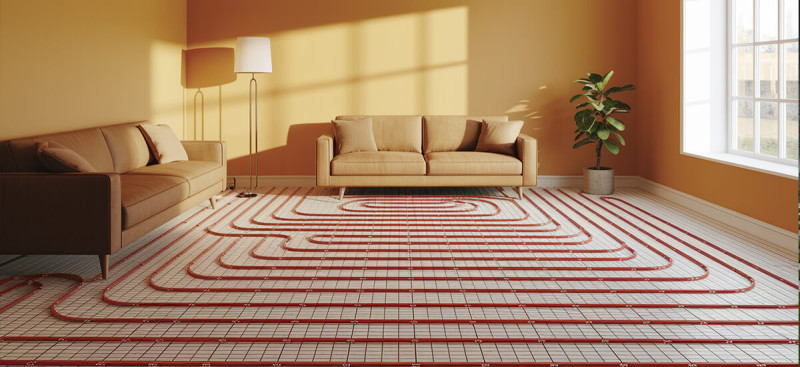
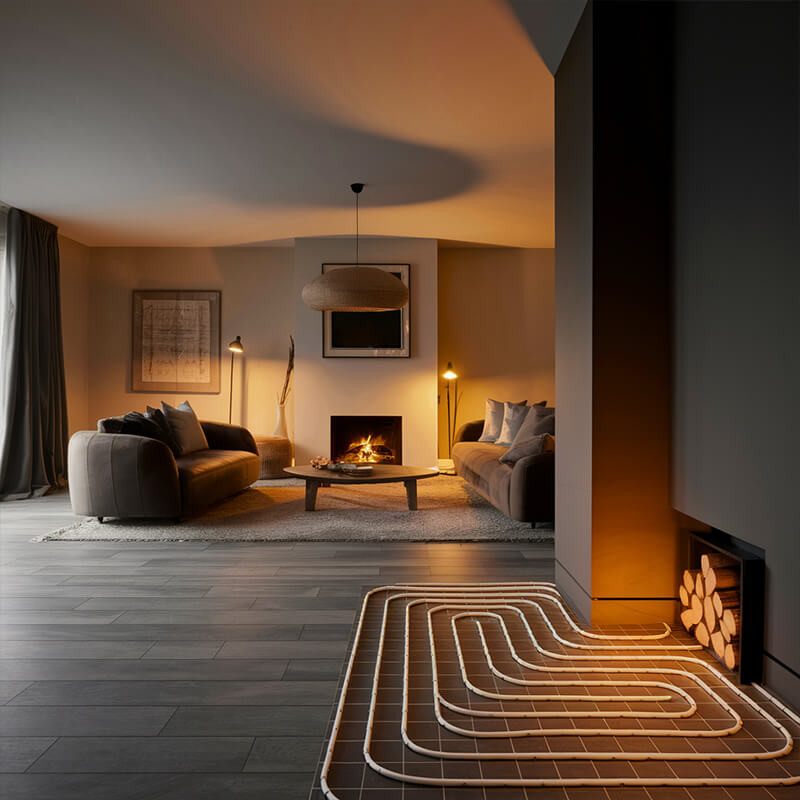
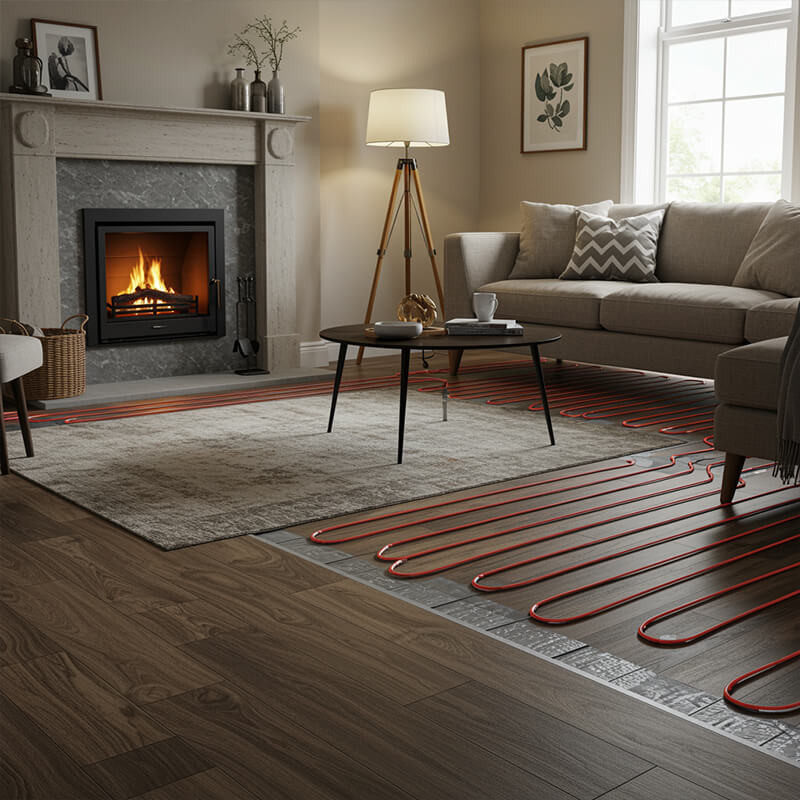
With water-based underfloor heating, pipes are laid closer together where more heat is needed or where you walk barefoot. Typical spacings from Uponor’s planning guidance for its wet systems are around 10cm in bathrooms and toilets, 20cm in kitchens and living rooms, 25cm in bedrooms and 10cm in edge zones near external walls and large windows. In living spaces, spacing should not exceed 30cm for comfort. In kitchens, heat the whole floor where possible, as layouts often change over the years. Your installer will confirm exact spacings for your system.
5 Reasons We Recommend Porcelain Tiles For Your Underfloor Heating Renovation
Porcelain tile is engineered to provide peak performance when paired with underfloor heating. Here are five structural reasons to choose porcelain for your renovation:
1. Exceptional Thermal Conductivity
Porcelain features high thermal conductivity, allowing heat from subfloor electric cables or water pipes to transfer rapidly to the room surface for even, hot-spot-free warming.
2. Low Coefficient of Thermal Expansion
Porcelain experiences minimal expansion and contraction under temperature swings. When installed with expansion joints, it maintains structural stability without warping or cracking.
3. Maximized Energy Efficiency
Because porcelain stores thermal energy efficiently, your heating system reaches target temperature quickly and maintains room heat for longer. This operational efficiency helps lower overall energy consumption and utility bills.
Tile’s low thermal resistance also lets your system deliver the heat it needs at lower water temperatures. That matters if you run a heat pump or condensing boiler, as both work most efficiently at low flow temperatures. In one example from Uponor’s planning guidance, a system delivers 50 W/m² with water at 45°C.
4. Universal Adhesive Compatibility
Porcelain bonds securely with flexible polymermodified tile adhesives, ensuring full contact over heated substrate layers without debonding over time.
5. Extreme Durability & Moisture Resistance
With a water absorption rate under 0.5%, porcelain will not absorb moisture from wet shoes, bathroom steam, or subfloor condensation, protecting your heating elements from liquid exposure.
In wet rooms and showers, waterproofing (tanking) should go on top of the screed, directly beneath the tile adhesive. This keeps water out of the screed and away from the heating system below.
Best Porcelain Tile For Your Underfloor Heating: 6 Top Types Of Tile
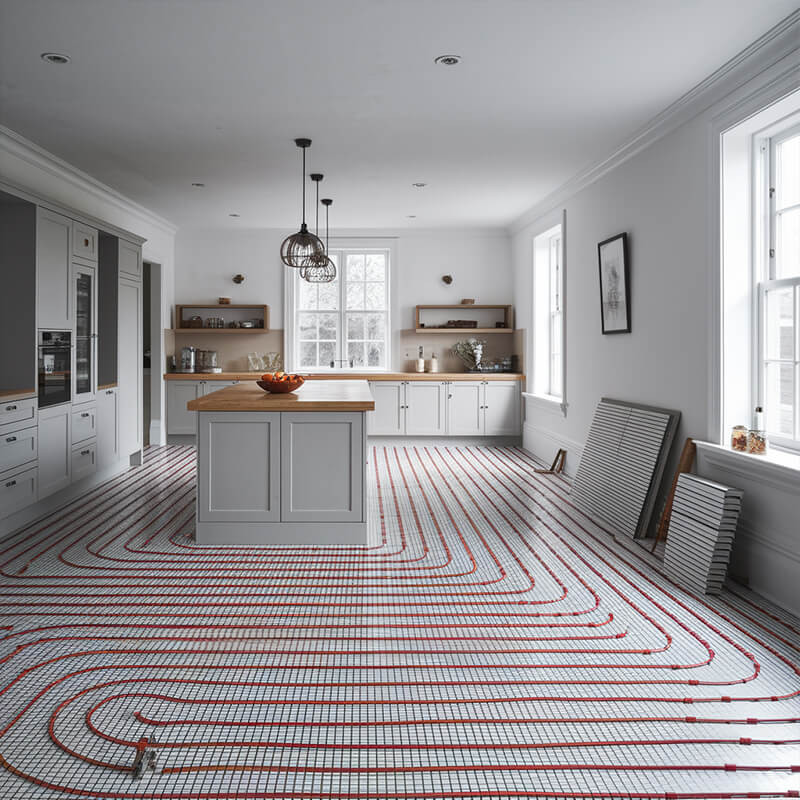
Having established porcelain tiles as the best tiles for underfloor heating, let’s now take a look at some of the gorgeous porcelain tiles you have to choose from!
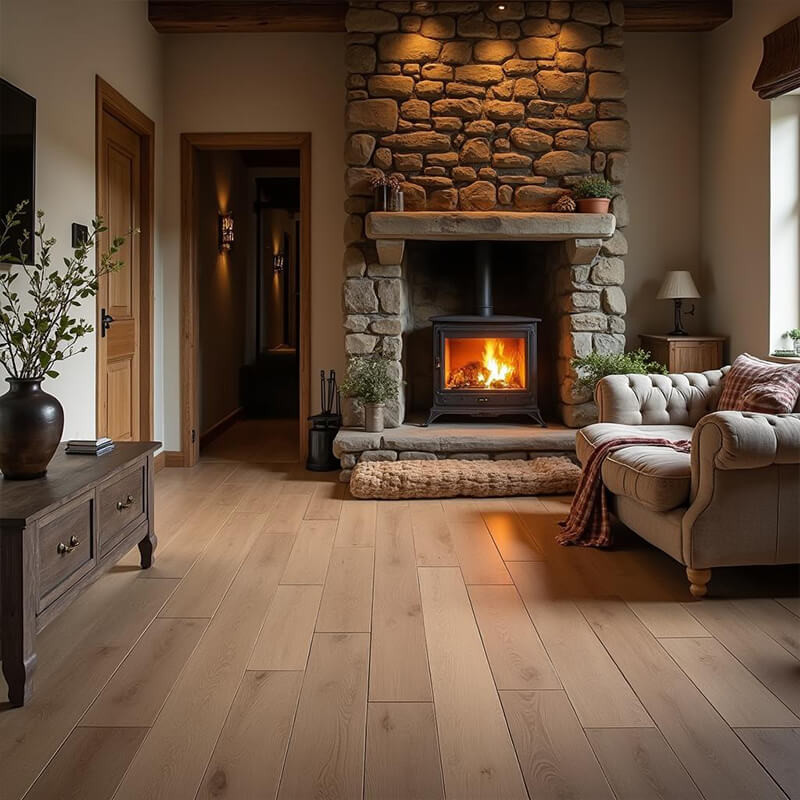
Wood-Effect Porcelain Tiles
If you want to know: are wood effect porcelain tiles suitable for underfloor heating? The answer is an emphatic yes. Real hardwood planks warp, shrink, and gap when exposed to radiant heat due to moisture loss in the timber. Wood-effect porcelain tiles deliver the exact texture, knotting, and visual warmth of natural timber while providing 100% waterproof performance and superior heat conduction.
Porcelain is the chameleon of the tile world, able to take on the look, shape, feel and finish of a huge array of different materials—from cement and marble to natural stone and even wood.
Our wood-effect porcelain tiles are designed so Ireland’s homeowners can embrace the calming, restorative properties of natural wood interiors without the hassle of maintaining, sealing and installing actual wood.
We happen to think that wood-effect porcelain tiles look particularly good in an underfloor-heated bathroom!
Hexagon tiles
Hexagon porcelain tiles add geometric character and classic styling to heated kitchen floors, hallways, and en-suites. Their dense porcelain composition ensures fast heat distribution, while the additional grout lines in geometric layouts provide added slip resistance in wet bathroom environments.
Hexagon tiles produce a dependably traditional aesthetic when used for flooring—one which is particularly well-suited to either the kitchen or bathroom.
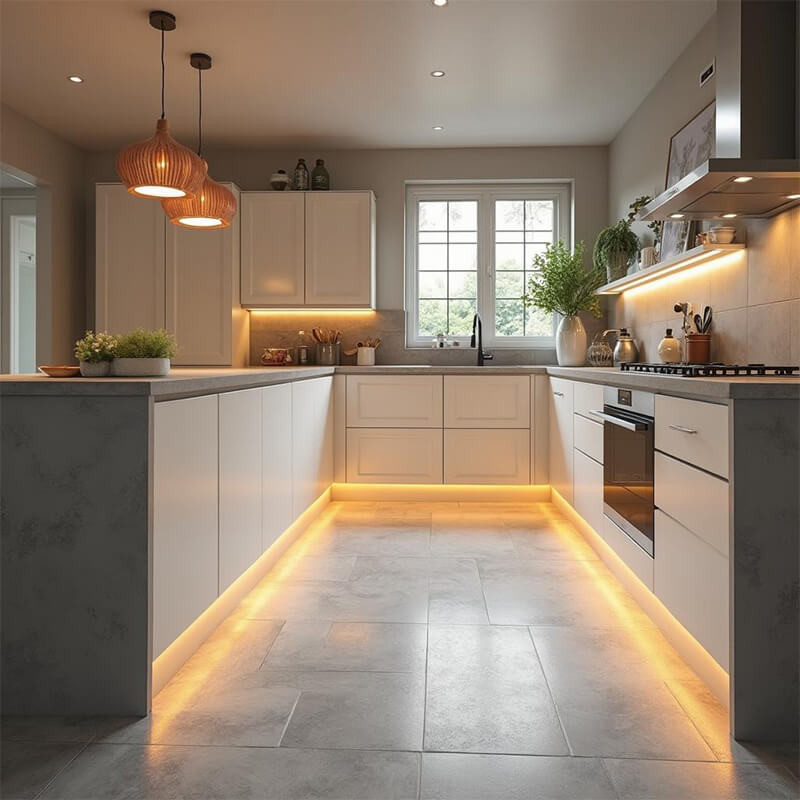
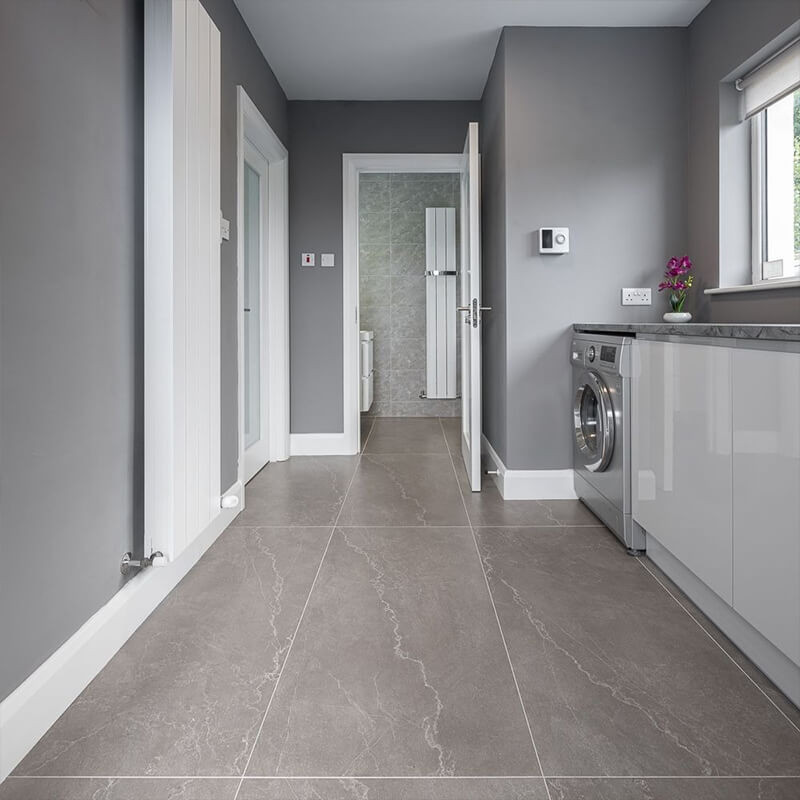
Large-format porcelain tiles
Large-format porcelain tiles (such as 60x60cm, 60x120cm, or 80x80cm) represent the ultimate choice for open-plan living areas and large kitchens with underfloor heating. Minimizing grout lines creates a sleek, modern floor plane that radiates heat uniformly across wide surface areas.
As we mentioned earlier, to get the most out of your underfloor heating it’s advisable to use larger format tiles. The less grout work there is and the greater the surface area of the porcelain, the easier it is for heat to disperse evenly across the tiled floor.
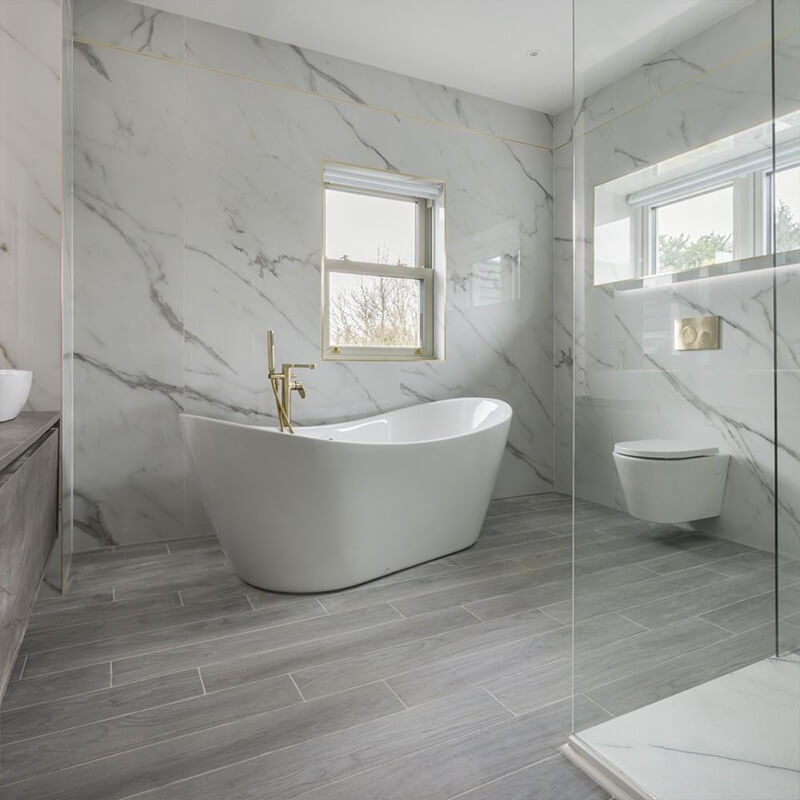
Marble-Effect Tiles
Natural marble is porous, prone to acid staining, and expensive to install over heating mats. Marble-effect porcelain tiles replicate the rich veining and polished or honed finishes of Carrara and Calacatta marble at a fraction of the cost—delivering a luxurious spa feel that retains warmth underfoot.
Marble interiors are undoubtedly some of the most opulent, elegant and therefore desirable interiors your money can buy... but that’s also the problem! Marble is exorbitantly expensive, meaning most homeowners can’t afford to kit out their homes with the stuff.
Marble-effect porcelain floor tiles, on the other hand, are just as affordable as any other porcelain tile, meaning you can create a gorgeous, marbled floor atop your underfloor heating without breaking the bank!
Patterned Porcelain Tiles
For period properties or statement feature floors, patterned porcelain tiles provide traditional Victorian or Mediterranean aesthetics. Unlike delicate encaustic cement tiles, patterned porcelain tiles do not require continuous sealing and will not degrade under low-temperature radiant heat.
If block colour or imitation effects aren’t your bag, remember there are always a variety of more traditional porcelain tile patterns to choose from!
Patterned porcelain has been popular for as long as porcelain tiles have been around, with a huge range of styles and patterns to choose from allowing you to flex your creative muscles.
Terrazzo-Effect Tiles
Inspired by classic Venetian architecture, terrazzo-effect porcelain tiles blend multi-colored stone speckles into a hard-wearing porcelain matrix. They retain thermal energy exceptionally well, making them ideal for high-traffic hallway and kitchen heating installations.
For something truly unique to decorate your newly heated floor, why not try a porcelain tile from our terrazzo range?
Underfloor Heating Compatibility Matrix
Here is how porcelain tiles compare to other common residential flooring options when installed over radiant underfloor heating systems:
| Flooring Material | Thermal Conductivity | Max Safe Temp | Warp / Gap Risk | Overall UFH Rating |
|---|---|---|---|---|
| Porcelain Tiles | Very High (≈ 1.3 W/m·K) | Unrestricted (>29°C) | None | Best (10/10) |
| Ceramic Tiles | High (≈ 1.0 W/m·K) | Unrestricted (>29°C) | Low | Excellent (9/10) |
| SPC Vinyl Plank | Medium (≈ 0.25 W/m·K) | Cap at 27°C | Low (Rigid Core) | Good (7/10) |
| Laminate Flooring | Low (≈ 0.13 W/m·K) | Cap at 27°C | Moderate | Fair (5/10) |
| Real Hardwood | Insulator (≈ 0.10 W/m·K) | Cap at 27°C | High (Cupping/Shrinking) | Poor / Not Recommended |
| Floor covering | Typical thermal resistance (m²K/W) |
|---|---|
| Ceramic / porcelain tiles, marble | 0.01–0.02 |
| PVC | approx. 0.025 |
| Parquet | 0.04–0.11 |
| Carpet | 0.06–0.15 |
| Recommended maximum for underfloor heating | 0.15 |
3 Top Tips For Installing Porcelain Floor Tiles On Underfloor Heating
We’ll close our guide to the six best tile styles for underfloor heating with a last few tips on how best to install them.
Follow these three top tips for installing tile on underfloor heating and we guarantee you’ll see an improvement in both the longevity of the tiles and the efficiency and quality of the heating.
To ensure your heated tile floor performs safely for decades without cracking or lifting, follow these three crucial installation standards:
1. Always Use S1/S2 Flexible Polymer-Modified Adhesive and Grout
Standard rigid tile adhesives will crack when subfloors expand under heat. Always use polymer-modified flexible adhesive (rated S1 or S2) and flexible grout specifically formulated for heated substrates to absorb thermal movement.
Check that every adhesive, primer and grout you use is marked as suitable for underfloor heating and can handle a continuous temperature of 50°C.
2. Install Sub-Tile Insulation Boards
Never lay heating mats or pipes directly onto bare concrete. Fitting coated XPS or cementitious insulation boards under the heating system stops downward thermal bleed, ensuring over 90% of heat radiates upward into your room.
3. Adhere strictly to Adhesive Curing Times Before Commissioning Heat
Do not switch on your underfloor heating system immediately after tiling. Allow adhesive and grout to cure fully for 14 to 28 days (check manufacturer specifications). Turning heat on prematurely forces moisture out of uncured adhesive, causing air voids, weak bonds, and cracked tiles.
Screed has its own timeline. Cement screed shouldn’t have its first heating cycle until at least 21 days after laying, and anhydrite screed until at least 7 days after, following the manufacturer’s heating protocol. This first heat-up is a system test, not a way to dry the screed, so moisture should still be checked before tiling. When you’re ready to tile, switch the heating off or turn it down so the screed surface is no warmer than 15–18°C.
Frequently Asked Questions: Tile & Underfloor Heating
Can you put underfloor heating under tiles?
Yes, tile is the most recommended surface material for underfloor heating. Both electric heating mats and water-based hydronic systems can be installed directly beneath porcelain or ceramic tiles using suitable self-leveling compound and flexible adhesive.
What is the best tile for underfloor heating?
Porcelain tile is the single best tile choice for underfloor heating. It combines high thermal conductivity with zero moisture absorption and minimal thermal expansion, making it more durable than ceramic or natural stone over heated subfloors.
Are wood effect porcelain tiles suitable for underfloor heating?
Yes, wood-effect porcelain tiles are 100% suitable for underfloor heating. They offer the warm aesthetic of real timber while providing fast heat transfer without the warping, gapping, or moisture damage associated with real wood.
Are ceramic or porcelain tiles better for underfloor heating?
Porcelain is superior to ceramic for heated floors. While both conduct heat well, porcelain’s higher density handles thermal stress better and offers higher resistance to impact and water absorption.
How long after tiling can you turn on underfloor heating?
You must wait between 14 to 28 days for the tile adhesive and grout to fully cure before turning on the heating system for the first time. Bring the temperature up gradually by 5°C per day to prevent thermal shock.
Conclusion
When installed correctly, 10mm porcelain tiles with underfloor heating provide a durable, efficient, and comfortable flooring solution—ideally suited to installation in bathrooms, wet rooms, toilets, kitchens, hallways and more, anywhere in Ireland.
To discover the perfect porcelain for your personal underfloor heating project, browse Tile Merchant porcelain tiles today. Remember, you can always order free cut samples of your favourite tiles before making your final choice!
For more style and installation advice, follow the Tile Merchant blog today, or give our dedicated sales team a call. Tile delivery is available seven days a week, direct to your doorstep, wherever you are in Ireland or Northern Ireland.
Technical figures in this guide are based on the European underfloor heating standard EN 1264 and Uponor’s Planning Information for Underfloor Heating/Cooling (2025).
Why Tile Merchant?
We offer extremely competitive pricing on our entire range of tiles and likewise. We stock a huge range of wall and floor tiles and our prices are competitive for retail and trade. Our stock is widely available in our tile stores in Ireland which are open 7 days a week.
Alternatively, if you’d prefer to shop our tiles online, we can supply you with samples delivered for free.

Article written by Calum
Cal Bannerman is a freelance writer, editor, podcaster and voice actor from the Scottish Borders. He runs the storytelling podcast "Stories from the Hearth" and lives in a wee Glasgow Flat with his partner and their cat".