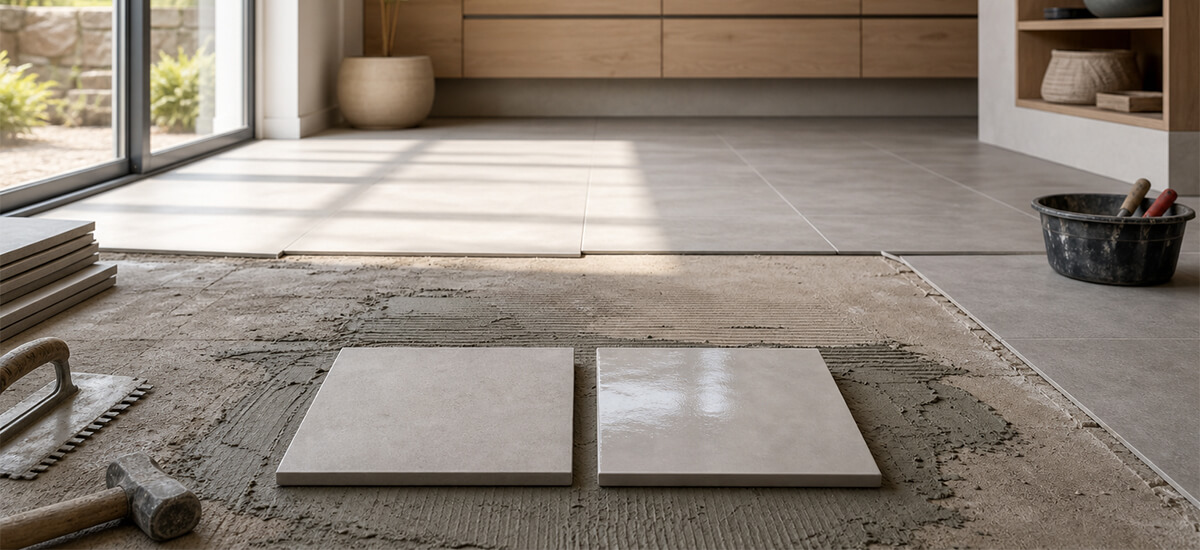
Two laminates can look almost identical on display. One says 8mm, the other says 12mm. Four millimetres doesn't sound like much, so what does it actually change?
Quick answer: the difference between 8mm and 12mm laminate is the thickness of the fibreboard core. 12mm feels more solid underfoot, copes better with small dips in the subfloor and sounds a little less hollow. 8mm sits lower, so it's easier around doors, thresholds and kitchen plinths, it's lighter to carry and cut, and it lets underfloor heating through a little faster. Neither thickness decides how well the surface resists scratches. That's the job of the AC rating.
We sell both, and both make good floors when they're matched to the room. Here's how to work out which one suits yours.
8mm vs 12mm laminate at a glance
| Feature | 8mm laminate | 12mm laminate |
|---|---|---|
| Feel underfoot | Firm on a flat subfloor | More solid, less give |
| Walking noise | Depends mostly on underlay | Slightly less hollow; underlay still matters most |
| Height with a 2mm underlay | About 10mm | About 14mm |
| Weight | Lighter to carry and cut | Roughly half as heavy again |
| Uneven subfloor | Less forgiving | Bridges small dips better |
| Underfloor heating | Slightly faster heat transfer | Works well with a low-resistance underlay |
| Scratch resistance | Set by the AC rating | Set by the AC rating |
| Water resistance | Available water resistant | Available water resistant |
What 8mm and 12mm actually measure
A laminate plank is a sandwich. There's a clear wear layer on top, a printed decorative layer, a high-density fibreboard (HDF) core and a balancing layer underneath. The planks click together and float over an underlay without glue.
The thickness figure mostly describes the HDF core. A thicker core is stiffer and more stable. It doesn't tell you how well the surface stands up to grit, chair legs or claws, because that's down to the wear layer, which is graded by AC rating.
One thing to watch: some brands quote thickness with a pre-attached underlay included. When you compare two products, check whether the figure is the board alone.
We stock 6mm, 10mm and 14mm laminate too, but 8mm and 12mm are the two thicknesses most people end up comparing, so that's the focus here.
Where 12mm laminate makes sense
A stiffer core bridges small ridges and hollows in the subfloor, so a 12mm floor tends to feel set in place, with less flex and less of that hollow click as you walk. You notice it most in hallways and open-plan rooms where you cross the floor dozens of times a day.
12mm is a good fit if:
- Your subfloor is sound but not perfectly flat, such as older floorboards.
- You're laying a large open-plan space and want a more substantial feel.
- The room takes heavy furniture that gets moved around.
- You're replacing carpet and already have plenty of clearance under the doors.

Where 8mm laminate makes sense
8mm earns its place where height and handling matter. Every millimetre counts when the new floor has to meet tiles in the next room, slide under a kitchen plinth or leave room for an integrated dishwasher to come back out.
8mm is a good fit if:
- Door clearance is tight and you'd rather not trim every door.
- The floor meets tiles or another floor and you want a low, neat threshold.
- You're fitting it yourself. Lighter packs are easier to carry upstairs, and thinner boards are quicker to cut.
- You have underfloor heating and want the best possible heat transfer.
- You're covering a large area, a rental or a property you're renovating to sell, and want to keep costs down.
On a flat subfloor with a good underlay, a well-made 8mm floor feels firm and settled. The subfloor and underlay do more for the feel than most people expect.
Noise: the underlay matters more than the thickness
There are two kinds of floor noise. Walking noise is the clack you hear in the room itself. Impact sound is what travels through the structure to the room below.
A thicker plank helps a little with walking noise. The underlay does most of the work on both, so 12mm isn't automatically quiet and 8mm isn't automatically loud. Pick your underlay for the room first: an acoustic underlay for upstairs rooms and apartments, a low-resistance one for underfloor heating, and one with a damp-proof layer over concrete.
If you live in an apartment, check whether your management company sets a minimum acoustic standard for hard floors before you order. Our guide to laminate flooring underlay covers the types and how to lay them.
Durability: check the AC rating, not the thickness
The AC (abrasion class) rating tells you how the surface handles scratches, scuffs and grit. It runs from AC1 to AC5:
- AC3 suits moderate household traffic, such as bedrooms.
- AC4 suits busy homes, hallways and light commercial use.
- AC5 suits the heaviest domestic use and commercial spaces.
An 8mm AC4 floor will hold its looks better than a 12mm AC3 floor in a busy hallway. So buy for the wear rating first, then use thickness to decide on feel and floor height. For homes with kids, dogs and muddy boots, our AC5 ranges, including Milano, Mammut, Robusto and Deco, give you the most headroom.
Pro tip: Thickness, AC rating and underlay are three separate decisions. Settle the AC rating for the traffic, the underlay for the room, then the thickness for the height and feel you want.

Underfloor heating: both work, 8mm has a slight edge
Underfloor heating pushes heat up through everything above it, and every layer adds thermal resistance. Manufacturers commonly set a limit of 0.15 m²K/W for the laminate and underlay combined.
HDF resists heat in proportion to its thickness, so an 8mm board uses up less of that allowance than a 12mm board. That leaves more room for the underlay. 12mm still works on underfloor heating, as long as you pair it with a thin, low-resistance underlay rather than standard foam. Expect it to warm up a little more slowly.
Whichever thickness you choose, confirm the product is approved for underfloor heating and check the underlay's thermal resistance before you buy.
Water resistance: kitchens, utility rooms and bathrooms
All the laminate we sell is water resistant, in every thickness. Water resistant isn't the same as waterproof. It means everyday spills and splashes won't harm the floor if you wipe them up, which makes laminate a practical choice for kitchens and utility rooms. Standing water, a leaking appliance left for hours, or a floor that's regularly soaked is a different matter.
Thickness doesn't change this: a 12mm board isn't more waterproof than an 8mm one. For bathrooms, en-suites and anywhere that gets properly wet, SPC flooring is the waterproof option. Our vinyl vs laminate comparison guide explains the difference.
Fitting: doors, thresholds and expansion gaps
A 12mm floor plus underlay adds around 14mm to your floor height. An 8mm floor adds around 10mm. Either can catch a door that cleared the old carpet, so measure before you order.
- Measure the gap under each door and allow for the plank, the underlay and a few millimetres spare.
- Plan transitions where laminate meets tiles or another floor. Threshold trims come in different heights, so pick one that matches your build-up.
- Leave the expansion gap the manufacturer specifies (often around 10mm) around walls, pipes and door frames.
- Let the packs settle flat in the room for 48 hours before fitting.
- Check the subfloor flatness tolerance in the fitting guide. Longer planks, such as 185 x 24cm, need a flatter subfloor than shorter ones like 60 x 10cm.
Our range runs from 60 x 10cm planks up to 185 x 24cm, with formats such as 121.8 x 19.8cm, 138 x 19cm and 184.5 x 18.8cm in between.

So, 8mm or 12mm?
Choose 12mm for a more solid feel, a subfloor that isn't perfectly flat, or a big open-plan room where you want the floor to feel substantial.
Choose 8mm where floor height is tight, where it meets tiles or kitchen units, for easier DIY handling, for the best heat transfer on underfloor heating, or to cover a large area on a tighter budget.
In both cases, compare the AC rating and underlay before the thickness number.
Your pre-order checklist
- Check your subfloor type and flatness, and choose your underlay.
- If you have underfloor heating, confirm the build-up stays under the manufacturer's limit.
- Measure door clearances, thresholds and expansion gaps.
- Check the AC rating against the traffic in the room.
- See the floor in person or hold a plank in your hand before you commit.
Frequently asked questions
Is 12mm laminate better than 8mm?
Not better, different. 12mm feels more solid and copes better with small subfloor imperfections. 8mm sits lower, weighs less and transfers underfloor heating slightly better. Scratch resistance depends on the AC rating, not the thickness.
Is 8mm laminate thick enough?
Yes, for most rooms. On a flat subfloor with a good underlay, 8mm makes a firm, durable floor. Choose an AC4 or AC5 rating for busy areas.
Is thicker laminate more waterproof?
No. Water resistance comes from the board's core and joint treatment, not its thickness. Laminate is water resistant, not waterproof. For bathrooms, choose SPC flooring.
Can I put 12mm laminate on underfloor heating?
Yes, if the product is approved for underfloor heating and you use a low-resistance underlay, so the combined build-up stays within the manufacturer's limit, commonly 0.15 m²K/W.
Do I need underlay with 8mm or 12mm laminate?
Yes. Laminate floats, so it needs an underlay unless one is pre-attached. The underlay affects noise, comfort and moisture protection more than the plank thickness does.
How thick is laminate flooring?
Laminate usually comes in 6mm to 14mm. We stock 6, 8, 10, 12 and 14mm. 8mm and 12mm are the most common choices for homes in Ireland.
Can I use laminate in a kitchen?
Yes. Water-resistant laminate handles everyday kitchen spills as long as you wipe them up. Avoid it where water may sit for long periods.
Need a hand choosing?
If you're still weighing up 8mm against 12mm, get in touch. You can email us, message us on WhatsApp or give us a call, and we'll help you match the thickness, AC rating and underlay to your room. Or call into one of our showrooms in Ireland open seven days a week, where you can see our laminates on display.
Browse our full laminate flooring range, or go straight to 12mm laminate flooring.

Why Choose Tile Merchant?
We offer extremely competitive pricing on our entire range of tiles, paving, wall panelling and likewise. We stock a huge range of wall and floor tiles, and our prices are competitive for retail and trade. Our stock is widely available in our tile stores in Ireland, which are open 7 days a week.
Alternatively, if you’d prefer to shop our tiles online, we can supply you with free samples delivered for free.

 Website