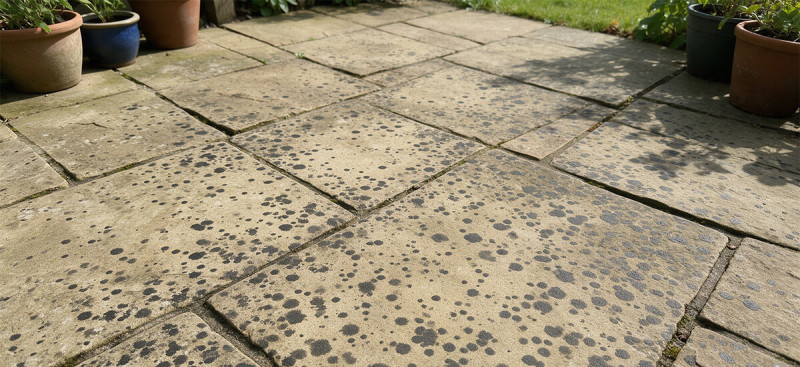

You rinse the patio on a dry Saturday and it looks great for about a week. Then the dark freckles come back, a little more of them each time, and the slabs feel slick underfoot after the first proper bit of rain.
If that sounds familiar, you're in good company. Black spots are one of the most common complaints we hear about Irish patios, and the frustrating part is that "black spots" is a catch-all name. Several different things leave dark marks on paving, and each one needs a different fix. Scrub the wrong thing with the wrong product and you can waste a weekend or damage the stone.
So before anyone reaches for the pressure washer, let's work out what's actually growing (or staining) on your slabs.
What causes black spots on patio slabs?
Almost every case falls into one of three buckets.
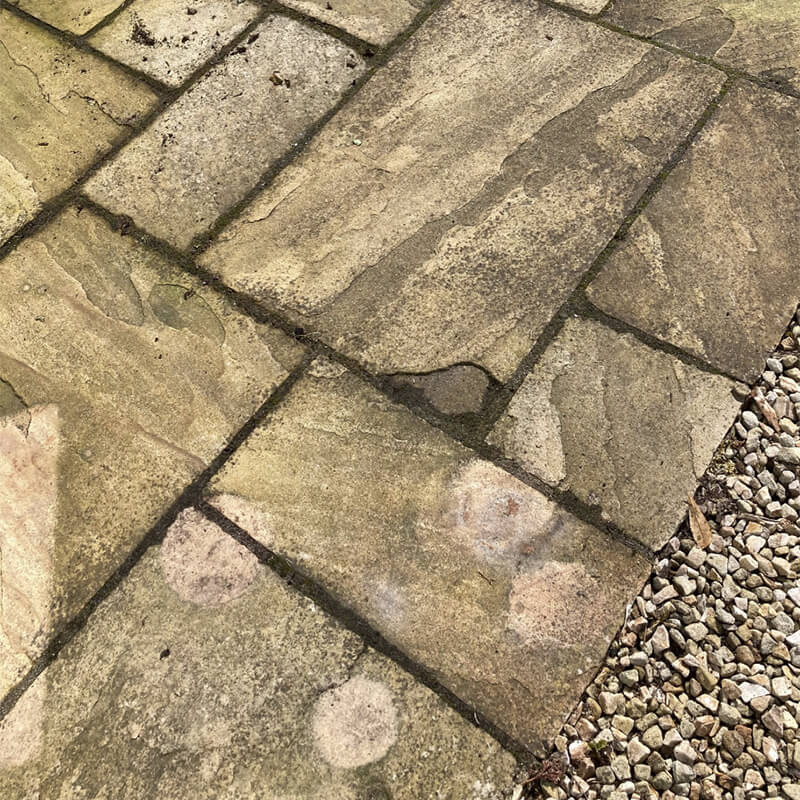
Biological growth is the big one. Most often it's black lichen, the cause behind what many people call "patio black spot". Algae and mould can also darken slabs, particularly in damp corners. They all start from airborne spores that land on the surface, then settle in wherever there's moisture and a bit of texture to hold onto.
Staining and runoff deposits are the second bucket. Dirty water, leaf tannins, sap and mineral-laden runoff can dry into pores and leave dark patches or streaks. These often follow drip lines from gutters, trees and overhanging plants.
Iron and rust staining is the third. Metal furniture feet, plant pot stands, tools, fixings and even a forgotten watering can corrode when they sit on damp stone. The marks tend to look orange-brown, though old rust can darken to something close to black.
The common thread is moisture. Spots appear where slabs stay wet longest: shaded corners, the base of walls, spots under trees, areas with poor drainage and surfaces that never get much airflow. Add surface porosity and you have the perfect set-up. Our step-by-step removal guide notes that black spots on natural stone paving can take hold during Ireland's wetter months, and anyone with a north-facing garden will tell you the same.
There's also a reason a quick blast with the pressure washer disappoints. Lichen roots into the microscopic pores of natural stone, so a jet of water tends to clip the top off it while the anchor stays put. Tile Merchant's guide describes black lichen as immune to simple pressure washing, and that matches what most Irish homeowners find when the spots reappear within weeks.
What are the black spots on patio slabs? A quick way to tell
Here's a five-minute diagnosis you can do with a stiff brush and a bucket of water. It saves you from buying the wrong product.
Check how it behaves
-
Does it scrub off with a brush and soapy water? If yes, it's most likely surface algae, mould or general grime.
-
Does it feel crusty, rough or raised, in small round or patchy dots? That points to lichen. It won't budge much with scrubbing.
-
Is it slimy or slippery when wet, with a green-black tinge? That's typically algae or a mould film, especially if it's in a damp, low-sun area.
-
Is there metal nearby, and are the marks rusty-orange or brown, with a drip or ring pattern? That's iron staining, not a living growth.
- Is the staining in streaks running away from a gutter, wall or tree? That's runoff.
Where it shows up tells you a lot
Lichen spots tend to be scattered across the slab like someone flicked a paintbrush at it. Algae and mould gather in bands along shaded edges and low spots. Rust stains sit directly under or around the object that caused them.
A simple way to remember it: lichen is crusty and anchored, algae is slick and surface-level, and rust is rusty and local.
| What you see | Likely cause | Does a brush shift it? |
|---|---|---|
| Hard, dark circular dots | Black lichen | Barely |
| Slimy dark-green or black film | Algae or mould | Mostly |
| Orange-brown marks near metal | Iron/rust staining | No (needs a rust-specific approach |
| Dark streaks below drip points | Runoff and organic staining | Sometimes |
Not sure which one you're dealing with? Treat it as lichen only if the scrub test fails and the marks are crusty. Otherwise start gentler.
What causes black spots on Indian sandstone?
Indian sandstone is a lovely patio stone, and a very popular one in Ireland. It's also porous, which is the root of the problem.
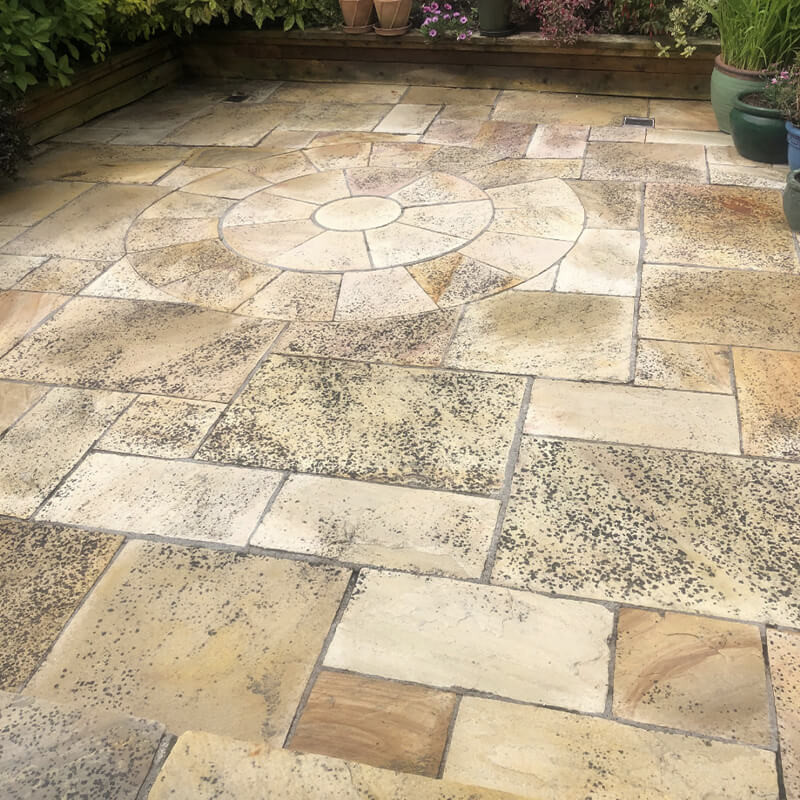
Those microscopic pores give spores somewhere to settle and hold on. Once lichen or algae gets going, it roots in rather than sitting on top. Add Irish weather (plenty of rain, long stretches of damp, not much drying time in winter) and you've got ideal conditions. The riven, textured surface that makes sandstone grippy and attractive also holds moisture a little longer than a smooth surface would.
Shade makes it worse. A sandstone patio that gets sun most of the day may stay fairly clear for years, while the shaded half by the fence can darken in a single season.
Setting realistic expectations: if you're asking how to get black spots off an Indian sandstone patio, a surface wash won't be enough for embedded lichen. A deep-penetrating treatment that breaks the bond between the lichen and the stone does the heavy lifting. This is where a dedicated product like Stontex Black Spot Remover comes in. Tile Merchant is the official Stontex distributor in Ireland, and the formula is designed to treat lichen without damaging the stone's structure.
Then comes the part people skip. After you've restored the slabs, seal them. Porous natural stone needs regular annual sealing to keep water and spores from getting a grip again. A breathable water-based product such as Stontex Indian Sandstone Sealer keeps the natural matt finish while helping the surface shed moisture. Cleaning without sealing is why so many patios end up back at square one by the following winter.
What causes black spots on Indian limestone?
The causes are much the same as sandstone: porous stone, damp conditions, shade and time. Lichen and algae love limestone just as much. The difference is how easily you can hurt it while trying to help.
Limestone is sensitive to acid. That includes vinegar, which a lot of people reach for first because it's cheap and already in the kitchen cupboard. On limestone (and travertine), vinegar can cause permanent acid etching, leaving dull, rough patches that no amount of scrubbing will fix. And the sting in the tail is that vinegar is generally ineffective against deep-seated lichen anyway. You can end up with etched stone and the spots still there.
So with limestone, go in this order:
-
Test any product in a hidden spot first. A corner under a planter or a slab edge works well.
-
Start with the gentlest option: a stiff brush, clean water and a mild patio cleaner.
-
Only escalate to a purpose-made black spot treatment if the marks don't shift, and follow the instructions to the letter.
-
Keep acids away from the stone altogether.
If you're thinking "can you use vinegar on a limestone patio?", the short answer is no, don't risk it.
What causes black spots on outdoor porcelain tiles?
Good news for anyone with a porcelain patio: it's the least likely of the three to give you trouble. Porcelain is non-porous, so spores and stains have far less to grip. Tile Merchant's guidance is that outdoor porcelain is unlikely to pick up mould or black spots and doesn't need sealing the way natural stone does.
That doesn't mean the tiles are immune to dark marks. When we hear about persistent spots on porcelain, it usually comes down to one of these:
-
Grout lines and edges. Grout is more porous than the tile, so algae and mould settle there first and can spread outward onto the surface.
-
Moisture traps. Shaded corners, spots with poor falls, and areas where leaves sit and rot all keep the surface wet.
-
Rust or runoff. Metal furniture feet, plant stands and drips from above can mark even a non-porous tile.
-
A film of dirt and organic matter. Over time, a thin layer builds up and gives growth something to feed on.
For porcelain, your job is simpler. Clear the organic buildup, give the grout some attention and fix whatever is keeping the surface damp. No annual sealing required for the tile itself. If you're still choosing a surface for a shady spot, this is a strong argument for porcelain paving over porous stone, since it's far easier to keep clean in Irish conditions.
How to remove black spots safely without making things worse
Pick your method based on what you diagnosed above, not on what's closest to hand.
Method 1: vinegar (only for the right surface and the right problem)
Suitable for light algae or surface growth on non-limestone surfaces. Mix distilled white vinegar and water 50:50, apply it to the patio, leave it for around 20 to 25 minutes, scrub and rinse thoroughly. Never use it on limestone or travertine, and don't expect it to beat embedded lichen.
Method 2: low-pressure power washing
Always start at a low setting and work up only if you need to. Be extra careful around grouted areas, which are more prone to damage. Too much pressure blasts out jointing sand and can roughen the surface, which gives growth even more to cling to. Keep the nozzle moving, and keep it a sensible distance from the slab.
Method 3: a dedicated black spot remover for embedded lichen
This is the one for stubborn dark circular marks. With Stontex Black Spot Remover:
-
Apply it undiluted, at roughly 1 litre per 5m².
-
Brush it in vigorously so it gets into the surface.
-
Leave it to soak for at least 2 hours, or overnight for heavily stained areas.
-
Wash away the dead lichen. If you use a power washer, set it to low pressure and take care around the grouting.
On cost and coverage: the 5L carton is €44.99 and the product page quotes coverage of around 40m² per bottle. Our guide's application rate for stubborn staining is heavier at 1 litre per 5m², so for badly affected slabs budget towards the higher rate. Delivery is typically 2 to 4 days, which is handy if you're planning a weekend job.
Rust stains
These need a different approach to biological growth. Remove the metal source first, then use a rust-specific stain remover suitable for your stone type, and test it somewhere discreet. Using a lichen treatment on rust won't help.
Safety basics
-
Wear gloves and eye protection.
-
Protect nearby plants and rinse them if anything splashes.
-
Rinse the treated area thoroughly.
-
Never mix cleaning products. Acids and bleach together can release dangerous fumes, so use one product at a time and rinse fully in between.
If you want the full walk-through, our guide to cleaning natural patio slabs covers general cleaning methods as well.
How to stop black spots coming back
Removing them is half the job. Keeping them away is where your patio stays looking just-laid.
Control moisture. Sweep leaves off regularly, since wet leaf litter is a growth bed. Trim back overhanging branches and shrubs to let in light and air. Check that water runs off the slabs rather than pooling, and clear gutters and downpipes so they don't spill onto the same patch every time it rains.
Seal porous stone. After restoring sandstone or limestone, seal it. Plan to reseal annually, as the protective effect wears over time.
Keep metal off the surface. Use rubber or plastic feet on furniture, and lift pots onto stands that don't rust.
Use a seasonal routine. A deep clean in spring clears what built up over winter. A preventative treatment in autumn heads off regrowth before the wet, cooler months set in. That timing fits Irish weather well, because growth ramps up when the damp does.
When to call in a professional
DIY works for most patios. But step back if:
-
The spots keep returning quickly after you've treated them properly.
-
Water pools or runs unevenly, which suggests an installation issue like poor falls, wrong pointing or inadequate drainage that no cleaner will fix.
-
Persistent runoff staining keeps showing up in the same place.
-
The stone already looks etched or damaged from an earlier cleaning attempt.
At that point more scrubbing makes things worse, and a landscaper or paving installer can look at the underlying cause.
FAQ
Why won't pressure washing remove black spots?
Black lichen anchors into the stone's pores. A pressure washer removes surface dirt and sometimes the top of the growth, but the root system stays, so the spots return. Higher pressure isn't the answer, because it can damage the stone and grout.
Can vinegar remove black lichen?
Vinegar can help with light surface algae, but it's generally ineffective against deep-seated lichen. On limestone and travertine it can cause permanent acid etching, so avoid it there altogether.
Are black spots dangerous?
They're not a health emergency, but they can make slabs slippery when wet, particularly where algae or mould is involved. That's a practical reason to deal with them rather than leave them.
What's the difference between algae, mould and lichen on a patio?
Algae and mould tend to form slimy or patchy films on the surface, often in damp, shaded spots. Lichen is crustier, rooted into the stone, and appears as dark circular or patchy marks that resist normal washing.
How long does treatment take and when can I use the patio again?
It depends on the method. With Stontex, the soak time is at least 2 hours, or overnight for heavy staining, followed by washing off the dead lichen. Let the surface dry before putting furniture back, and follow the label instructions for the specific product you use. If you're sealing afterwards, the stone should be dry first.
The short version
Black spots on a patio aren't one problem. They're usually lichen, algae or mould, rust, or runoff, and they all love damp, shaded, porous surfaces. Diagnose first, treat the actual cause, and then seal and manage moisture so you aren't back with the brush next spring.
If lichen is your culprit, you can shop Stontex Black Spot Remover with delivery in 2 to 4 days, or call into one of our showrooms in Ireland, and ask the team which slabs and sealers suit your garden best.
Why Choose Tile Merchant?
We offer extremely competitive pricing on our entire range of tiles, paving, wall panelling and likewise. We stock a huge range of wall and floor tiles, and our prices are competitive for retail and trade. Our stock is widely available in our tile stores in Ireland, which are open 7 days a week.
Alternatively, if you’d prefer to shop our tiles online, we can supply you with free samples delivered for free.

 Website